

[2026] DP-100 Exam Dumps, Test Engine Practice Test Questions
Pass DP-100 exam [Feb 13, 2026] Updated 519 Questions
The DP-100 certification exam is an essential tool for professionals who want to demonstrate their expertise in designing and implementing data science solutions on Azure. Designing and Implementing a Data Science Solution on Azure certification exam is ideal for data scientists, software developers, and IT professionals who want to improve their knowledge and skills in Azure data science solutions. DP-100 exam is also suitable for professionals who want to advance their careers in data science.
NEW QUESTION # 65
You are using The Azure Machine Learning designer to transform a dataset containing the census data of all nations.
You must use the Split Data component to separate the dataset into two datasets. The first dataset must contain the census data of the United States. The second dataset must include the census data of the remaining nations.
You need to configure the component to create the datasets.
Which configuration values should you use? To answer, select the appropriate options in the answer area.
NOTE: Each correct selection is worth one point.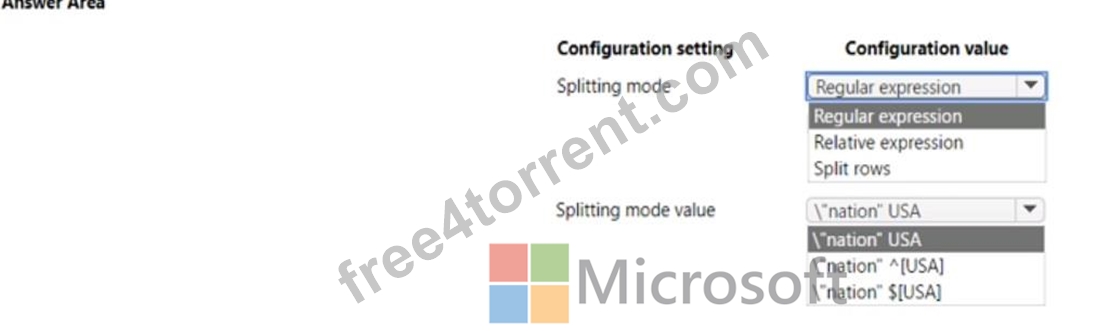
Answer:
Explanation: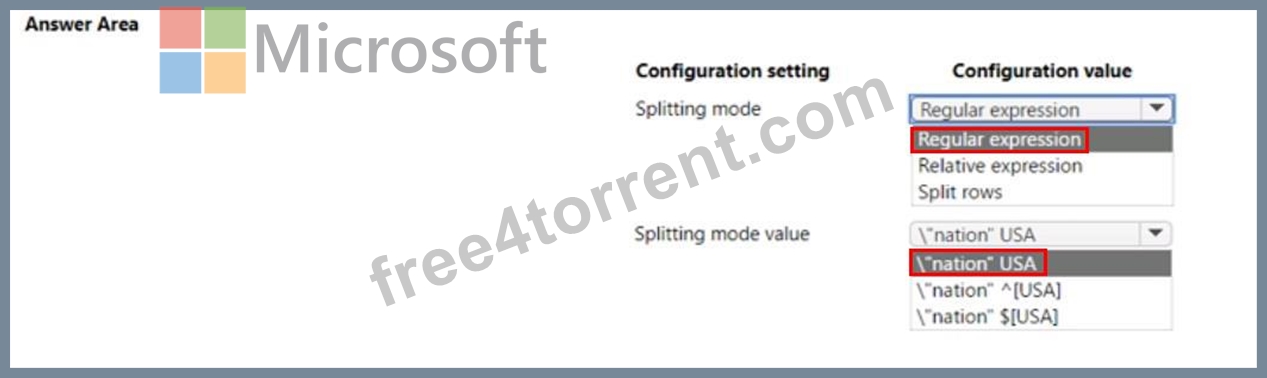
NEW QUESTION # 66
Hotspot Question
You are using a decision tree algorithm. You have trained a model that generalizes well at a tree depth equal to 10.
You need to select the bias and variance properties of the model with varying tree depth values.
Which properties should you select for each tree depth? To answer, select the appropriate options in the answer area.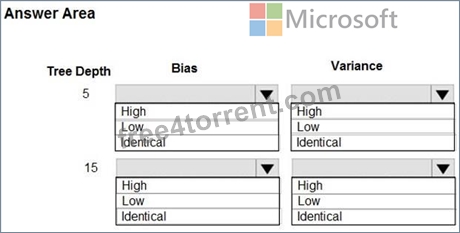
Answer:
Explanation: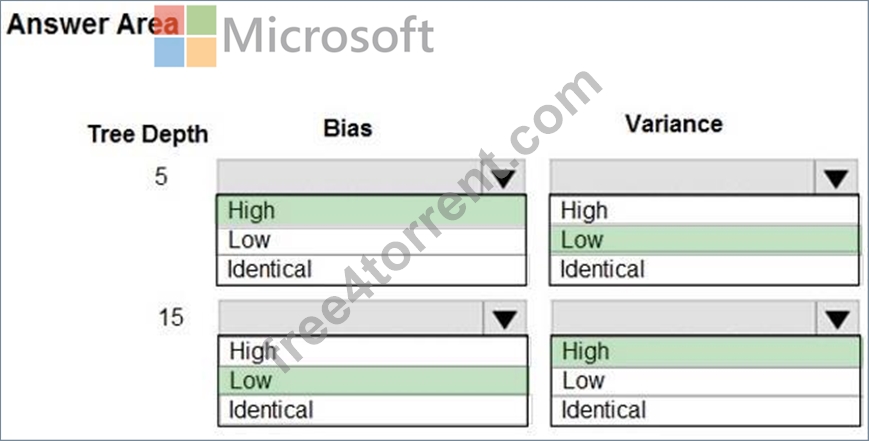
Explanation:
In decision trees, the depth of the tree determines the variance. A complicated decision tree (e.g.
deep) has low bias and high variance.
Note: In statistics and machine learning, the bias璿ariance tradeoff is the property of a set of predictive models whereby models with a lower bias in parameter estimation have a higher variance of the parameter estimates across samples, and vice versa. Increasing the bias will decrease the variance. Increasing the variance will decrease the bias.
References:
https://machinelearningmastery.com/gentle-introduction-to-the-bias-variance-trade-off-in- machine-learning/
NEW QUESTION # 67
You manage an Azure Machine Learning workspace by using the Python SDK v2.
You must create a compute cluster in the workspace. The compute cluster must run workloads and properly handle interruptions. You start by calculating the maximum amount of compute resources required by the workloads and size the cluster to match the calculations.
The cluster definition includes the following properties and values:
* name="mlcluster1''
* size="STANDARD.DS3.v2"
* min_instances=1
* maxjnstances=4
* tier="dedicated"
The cost of the compute resources must be minimized when a workload is active Of idle. Cluster property changes must not affect the maximum amount of compute resources available to the workloads run on the cluster.
You need to modify the cluster properties to minimize the cost of compute resources.
Which properties should you modify? To answer, select the appropriate options in the answer area.
NOTE: Each correct selection is worth one point.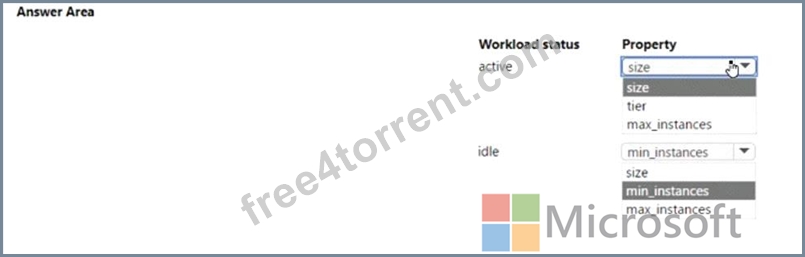
Answer:
Explanation: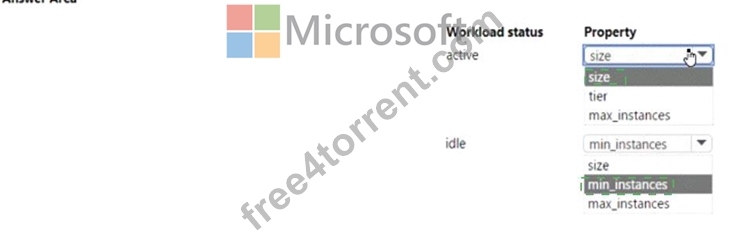
Explanation
NEW QUESTION # 68
You create an Azure Machine Learning compute resource to train models. The compute resource is configured as follows:
Minimum nodes: 2
Maximum nodes: 4
You must decrease the minimum number of nodes and increase the maximum number of nodes to the following values:
Minimum nodes: 0
Maximum nodes: 8
You need to reconfigure the compute resource.
What are three possible ways to achieve this goal? Each correct answer presents a complete solution.
NOTE: Each correct selection is worth one point.
- A. Azure Machine Learning designer
- B. Azure Machine Learning studio
- C. BuildContext class in Python SDK v2
- D. MLCIient class in Python SDK v2
- E. Azure CLI ml extension v2
Answer: A,D,E
Explanation:
Reference:
https://docs.microsoft.com/en-us/python/api/azureml-core/azureml.core.compute.amlcompute(class)
NEW QUESTION # 69
You manage an Azure Machine Learning workspace. You configure an automated machine learning regression training job by using the Azure Machine Learning Python SDK v2. You configure the regression job by using the following script: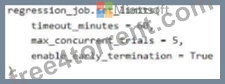
For each of the following statements, select Yes if the statement is true. Otherwise, select No.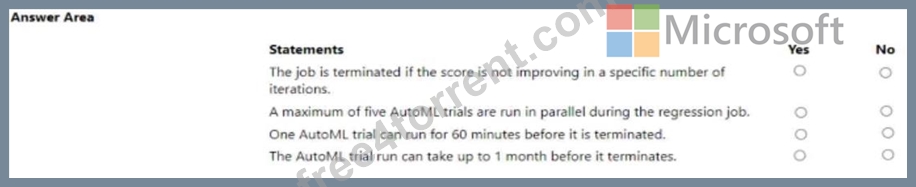
Answer:
Explanation: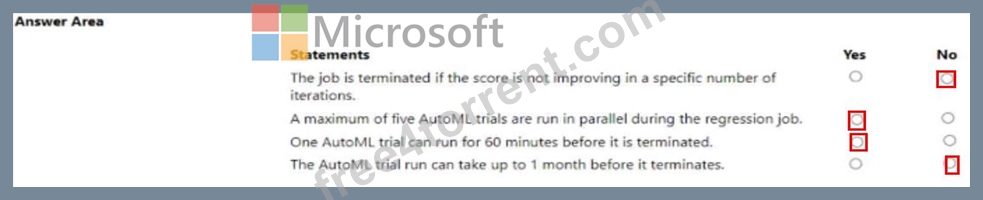
NEW QUESTION # 70
Your Azure Machine Learning workspace has a dataset named real_estate_data. A sample of the data in the dataset follows.
You want to use automated machine learning lo find the best regression model for predicting the price column. You need to configure an automated machine learning experiment using the Azure Machine Learning SDK. How should you complete the code? To answer, select the appropriate options in the answer area. NOTE: Each correct selection is worth one point.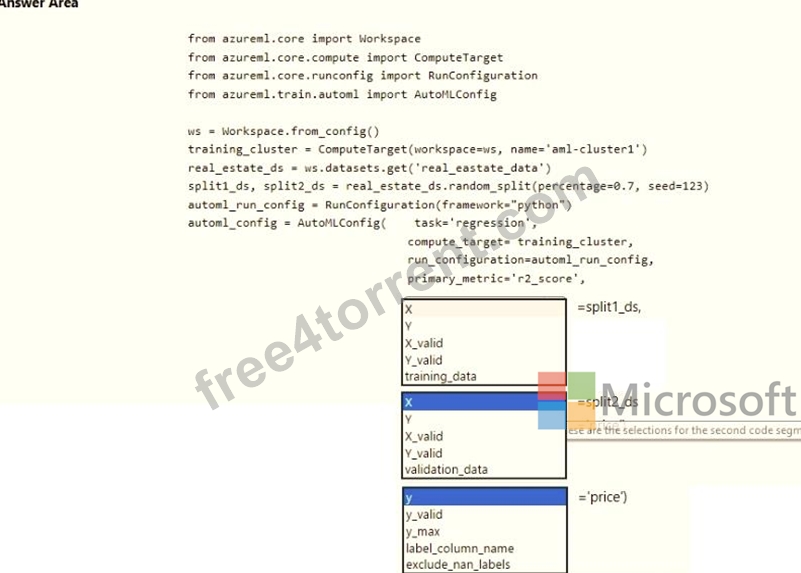
Answer:
Explanation: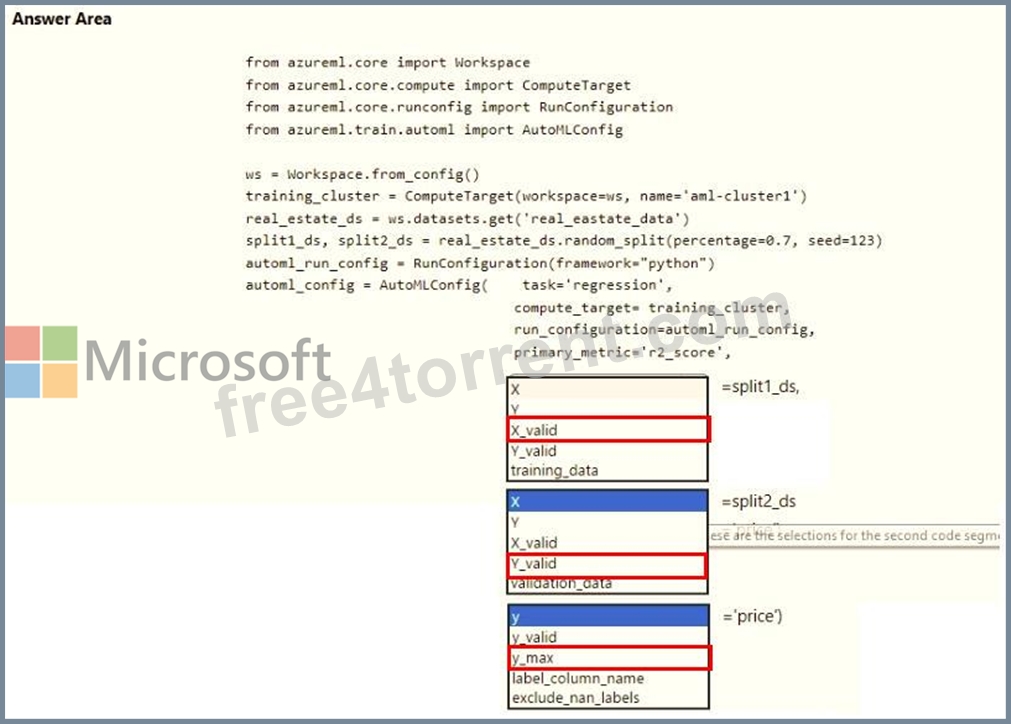
NEW QUESTION # 71
You create a binary classification model to predict whether a person has a disease.
You need to detect possible classification errors.
Which error type should you choose for each description? To answer, select the appropriate options in the answer area.
NOTE: Each correct selection is worth one point.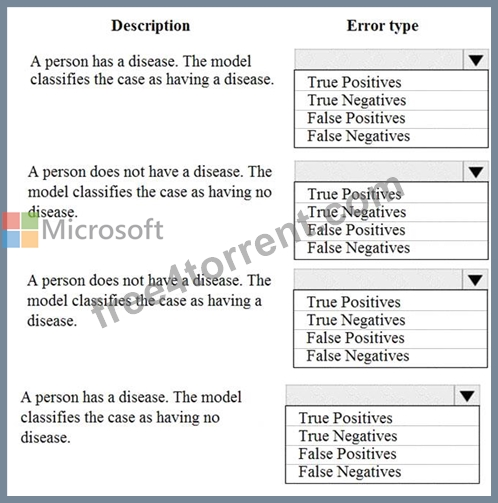
Answer:
Explanation: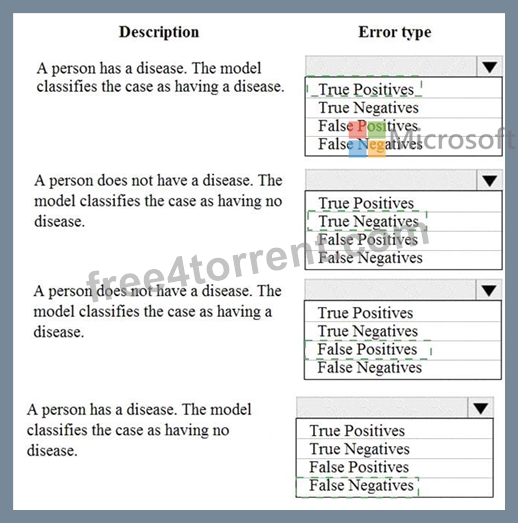
Explanation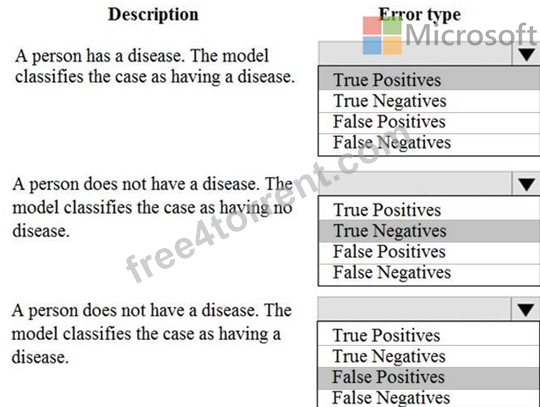
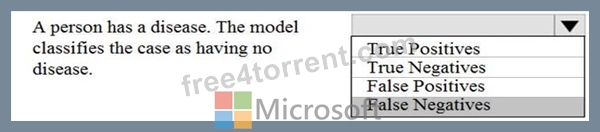
Box 1: True Positive
A true positive is an outcome where the model correctly predicts the positive class Box 2: True Negative A true negative is an outcome where the model correctly predicts the negative class.
Box 3: False Positive
A false positive is an outcome where the model incorrectly predicts the positive class.
Box 4: False Negative
A false negative is an outcome where the model incorrectly predicts the negative class.
Note: Let's make the following definitions:
"Wolf" is a positive class.
"No wolf" is a negative class.
We can summarize our "wolf-prediction" model using a 2x2 confusion matrix that depicts all four possible outcomes:
Reference:
https://developers.google.com/machine-learning/crash-course/classification/true-false-positive-negative
NEW QUESTION # 72
Note: This question is part of a series of questions that present the same scenario. Each question in the series contains a unique solution that might meet the stated goals. Some question sets might have more than one correct solution, while others might not have a correct solution.
After you answer a question in this section, you will NOT be able to return to it. As a result, these questions will not appear in the review screen.
An IT department creates the following Azure resource groups and resources: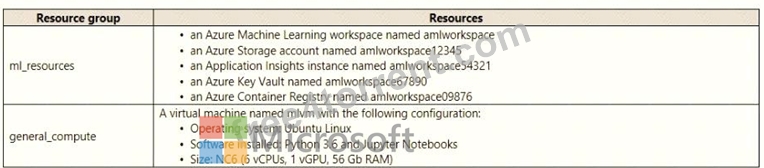
The IT department creates an Azure Kubernetes Service (AKS)-based inference compute target named aks-cluster in the Azure Machine Learning workspace. You have a Microsoft Surface Book computer with a GPU. Python 3.6 and Visual Studio Code are installed.
You need to run a script that trains a deep neural network (DNN) model and logs the loss and accuracy metrics.
Solution: Install the Azure ML SDK on the Surface Book. Run Python code to connect to the workspace. Run the training script as an experiment on the aks-cluster compute target.
Does the solution meet the goal?
- A. No
- B. Yes
Answer: A
Explanation:
Explanation
Need to attach the mlvm virtual machine as a compute target in the Azure Machine Learning workspace.
Reference:
https://docs.microsoft.com/en-us/azure/machine-learning/concept-compute-target
NEW QUESTION # 73
Note: This question is part of a series of questions that present the same scenario. Each question in the series contains a unique solution that might meet the stated goals. Some question sets might have more than one correct solution, while others might not have a correct solution.
After you answer a question in this section, you will NOT be able to return to it. As a result, these questions will not appear in the review screen.
You create an Azure Machine Learning service datastore in a workspace. The datastore contains the following files:
* /data/2018/Q1.csv
* /data/2018/Q2.csv
* /data/2018/Q3.csv
* /data/2018/Q4.csv
* /data/2019/Q1.csv
All files store data in the following format:
id,f1,f2,I
1,1,2,0
2,1,1,1
3,2,1,0
4,2,2,1
You run the following code:
You need to create a dataset named training_data and load the data from all files into a single data frame by using the following code:
Solution: Run the following code:
Does the solution meet the goal?
- A. No
- B. Yes
Answer: B
Explanation:
Use two file paths.
Use Dataset.Tabular_from_delimeted as the data isn't cleansed.
Note:
A TabularDataset represents data in a tabular format by parsing the provided file or list of files. This provides you with the ability to materialize the data into a pandas or Spark DataFrame so you can work with familiar data preparation and training libraries without having to leave your notebook. You can create a TabularDataset object from .csv, .tsv, .parquet, .jsonl files, and from SQL query results.
Reference:
https://docs.microsoft.com/en-us/azure/machine-learning/how-to-create-register-datasets
NEW QUESTION # 74
You deploy a model in Azure Container Instance.
You must use the Azure Machine Learning SDK to call the model API.
You need to invoke the deployed model using native SDK classes and methods.
How should you complete the command? To answer, select the appropriate options in the answer areas.
NOTE: Each correct selection is worth one point.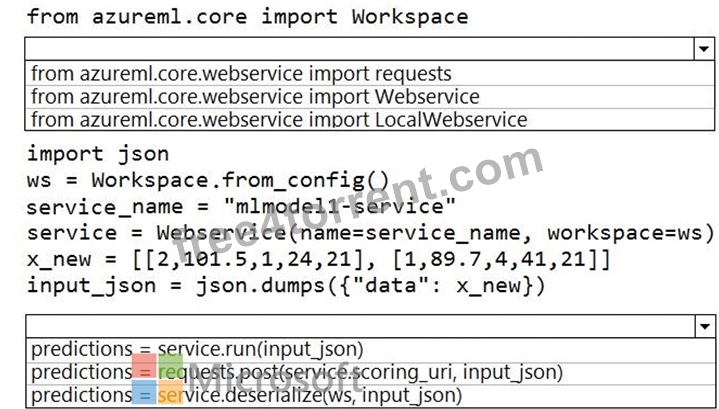
Answer:
Explanation: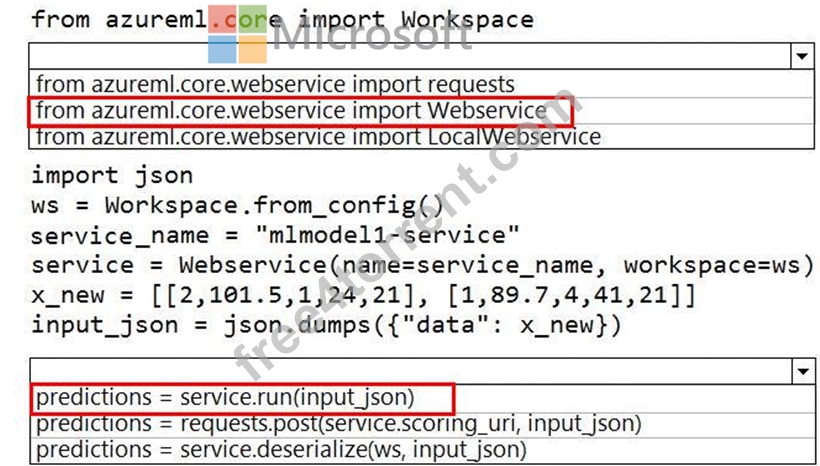
Reference:
https://docs.microsoft.com/bs-latn-ba/azure/machine-learning/how-to-deploy-azure-container-instance
https://docs.microsoft.com/en-us/azure/machine-learning/how-to-troubleshoot-deployment
NEW QUESTION # 75
Drag and Drop Question
You have an Azure Machine Learning workspace. You are running an experiment on your local computer.
You need to ensure that you can use MLflow Tracking with Azure Machine Learning Python SDK v2 to store metrics and artifacts from your local experiment runs m the workspace.
In which order should you perform the actions? To answer, move all actions from the list of actions to the answer area and arrange them in the correct order.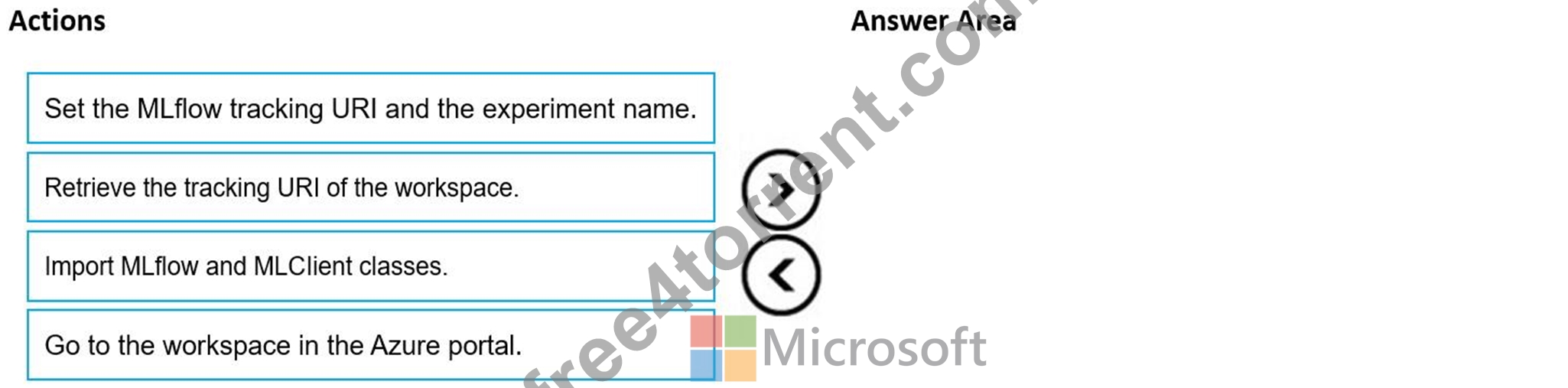
Answer:
Explanation: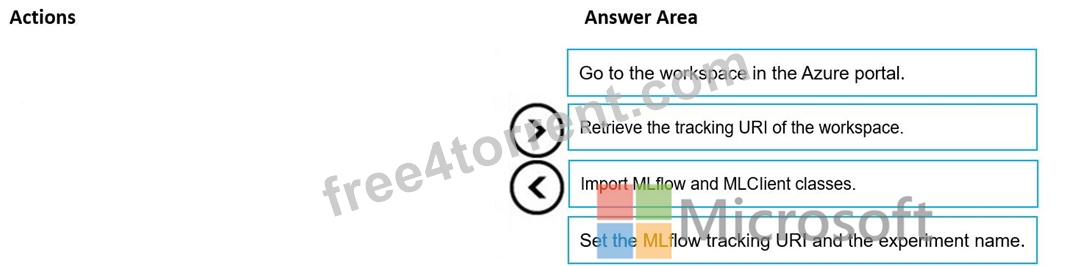
NEW QUESTION # 76
You define a datastore named ml-data for an Azure Storage blob container. In the container, you have a folder named train that contains a file named data.csv. You plan to use the file to train a model by using the Azure Machine Learning SDK.
You plan to train the model by using the Azure Machine Learning SDK to run an experiment on local compute.
You define a DataReference object by running the following code: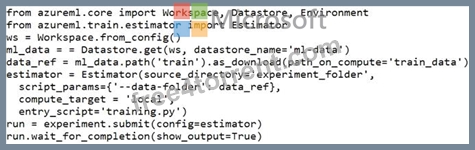
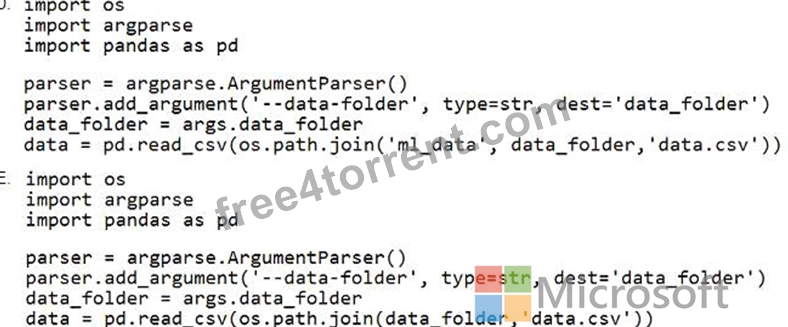
You need to load the training data.
Which code segment should you use?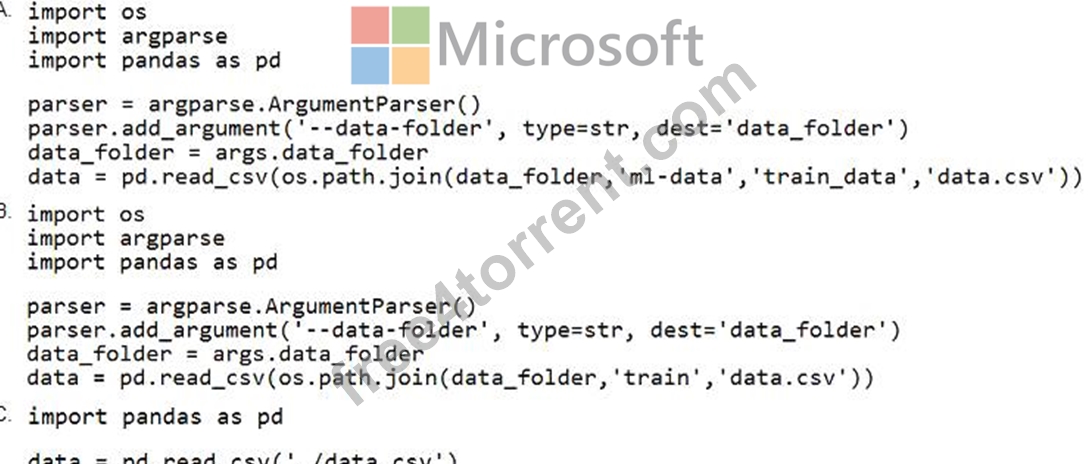
- A. Option E
- B. Option C
- C. Option A
- D. Option D
- E. Option B
Answer: A
Explanation:
Explanation
Example:
data_folder = args.data_folder
# Load Train and Test data
train_data = pd.read_csv(os.path.join(data_folder, 'data.csv'))
Reference:
https://www.element61.be/en/resource/azure-machine-learning-services-complete-toolbox-ai
NEW QUESTION # 77
You need to configure the Feature Based Feature Selection module based on the experiment requirements and datasets.
How should you configure the module properties? To answer, select the appropriate options in the dialog box in the answer area.
NOTE: Each correct selection is worth one point.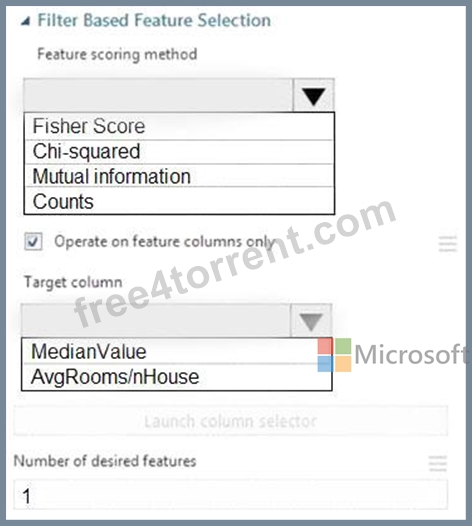
Answer:
Explanation: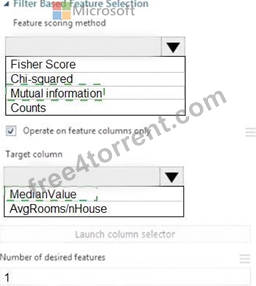
Explanation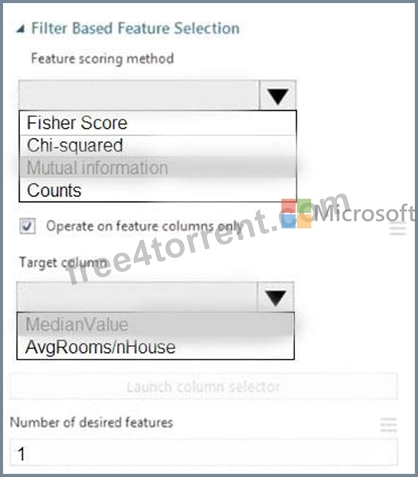
Box 1: Mutual Information.
The mutual information score is particularly useful in feature selection because it maximizes the mutual information between the joint distribution and target variables in datasets with many dimensions.
Box 2: MedianValue
MedianValue is the feature column, , it is the predictor of the dataset.
Scenario: The MedianValue and AvgRoomsinHouse columns both hold data in numeric format. You need to select a feature selection algorithm to analyze the relationship between the two columns in more detail.
References:
https://docs.microsoft.com/en-us/azure/machine-learning/studio-module-reference/filter-based-feature-selection
NEW QUESTION # 78
You create a new Azure subscription. No resources are provisioned in the subscription.
You need to create an Azure Machine Learning workspace.
What are three possible ways to achieve this goal? Each correct answer presents a complete solution.
NOTE: Each correct selection is worth one point.
- A. Use the Azure Command Line Interface (CLI) with the Azure Machine Learning extension to call the az group create function with --name and --location parameters, and then the az ml workspace create function, specifying -w and -g parameters for the workspace name and resource group.
- B. Use an Azure Resource Management template that includes a Microsoft.MachineLearningServices/ workspaces resource and its dependencies.
- C. Run Python code that uses the Azure ML SDK library and calls the Workspace.get method with name, subscription_id, and resource_group parameters.
- D. Navigate to Azure Machine Learning studio and create a workspace.
- E. Run Python code that uses the Azure ML SDK library and calls the Workspace.create method with name, subscription_id, resource_group, and location parameters.
Answer: A,B,D
Explanation:
Explanation
B: You can use an Azure Resource Manager template to create a workspace for Azure Machine Learning.
Example:
{"type": "Microsoft.MachineLearningServices/workspaces",
...
C: You can create a workspace for Azure Machine Learning with Azure CLI Install the machine learning extension.
Create a resource group: az group create --name <resource-group-name> --location <location> To create a new workspace where the services are automatically created, use the following command: az ml workspace create -w <workspace-name> -g <resource-group-name> D: You can create and manage Azure Machine Learning workspaces in the Azure portal.
* Sign in to the Azure portal by using the credentials for your Azure subscription.
* In the upper-left corner of Azure portal, select + Create a resource.
* Use the search bar to find Machine Learning.
* Select Machine Learning.
* In the Machine Learning pane, select Create to begin.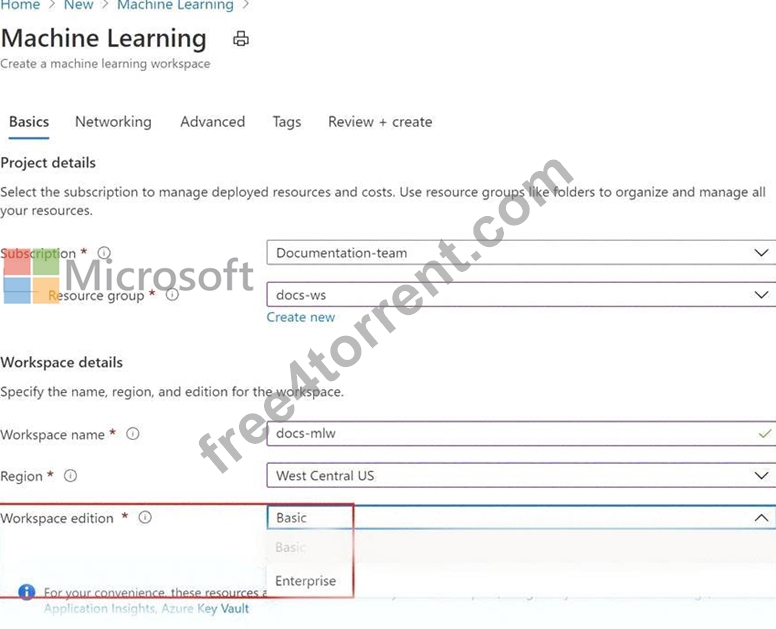
Reference:
https://docs.microsoft.com/en-us/azure/machine-learning/how-to-create-workspace-template
https://docs.microsoft.com/en-us/azure/machine-learning/how-to-manage-workspace-cli
https://docs.microsoft.com/en-us/azure/machine-learning/how-to-manage-workspace
NEW QUESTION # 79
Note: This question is part of a series of questions that present the same scenario. Each question in the series contains a unique solution that might meet the stated goals. Some question sets might have more than one correct solution, while others might not have a correct solution.
After you answer a question in this section, you will NOT be able to return to it. As a result, these questions will not appear in the review screen.
You create an Azure Machine Learning pipeline named pipeline1 with two steps that contain Python scripts. Data processed by the first step is passed to the second step.
You must update the content of the downstream data source of pipeline1 and run the pipeline again.
You need to ensure the new run of pipeline1 fully processes the updated content.
Solution: Set the allow_reuse parameter of the PythonScriptStep object of both steps to False.
Does the solution meet the goal?
- A. No
- B. Yes
Answer: B
NEW QUESTION # 80
You create a script for training a machine learning model in Azure Machine Learning service.
You create an estimator by running the following code: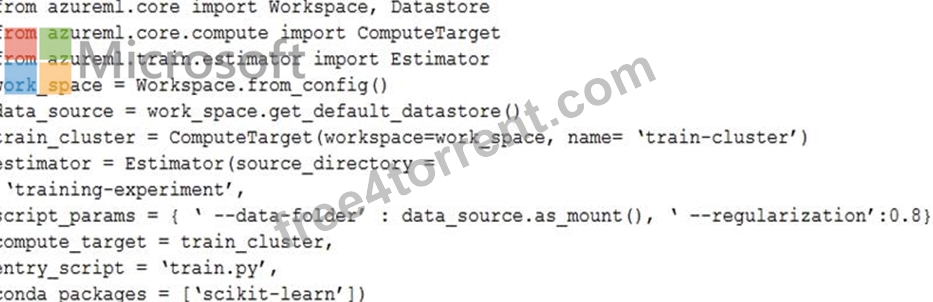
For each of the following statements, select Yes if the statement is true. Otherwise, select No.
NOTE: Each correct selection is worth one point.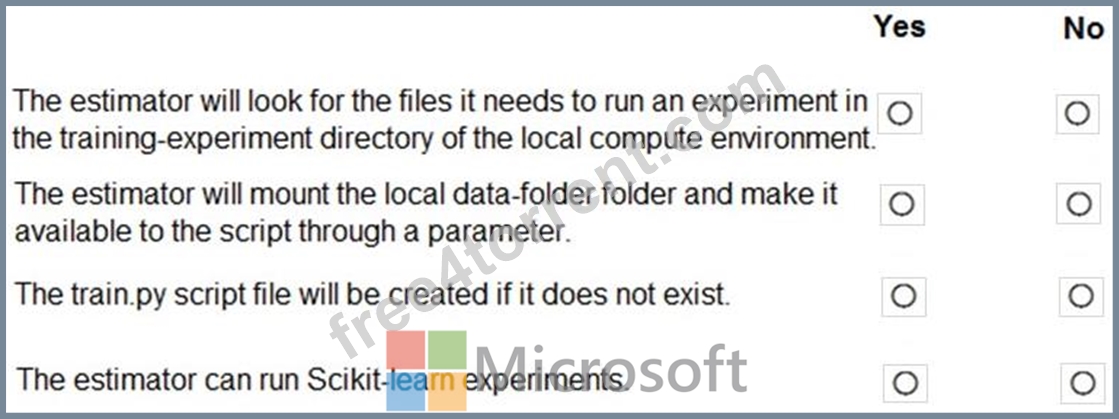
Answer:
Explanation: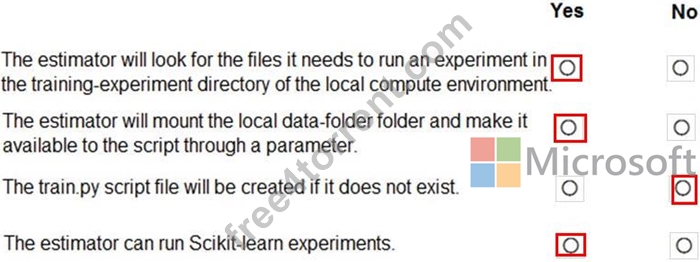
NEW QUESTION # 81
You are a lead data scientist for a project that tracks the health and migration of birds. You create a multi-image classification deep learning model that uses a set of labeled bird photos collected by experts. You plan to use the model to develop a cross-platform mobile app that predicts the species of bird captured by app users.
You must test and deploy the trained model as a web service. The deployed model must meet the following requirements:
An authenticated connection must not be required for testing.
The deployed model must perform with low latency during inferencing.
The REST endpoints must be scalable and should have a capacity to handle large number of requests when multiple end users are using the mobile application.
You need to verify that the web service returns predictions in the expected JSON format when a valid REST request is submitted.
Which compute resources should you use? To answer, select the appropriate options in the answer area.
NOTE: Each correct selection is worth one point.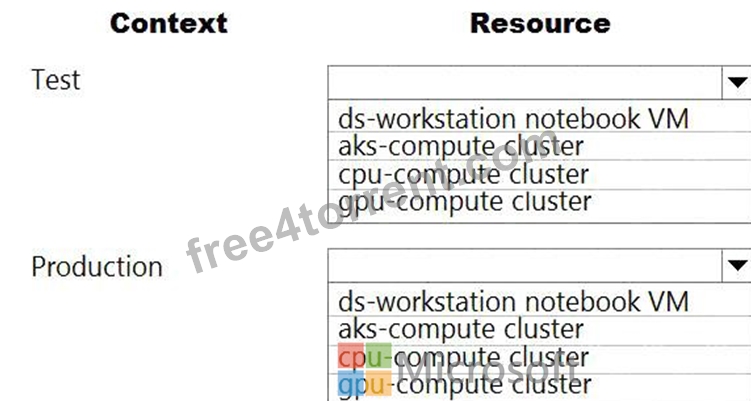
Answer:
Explanation: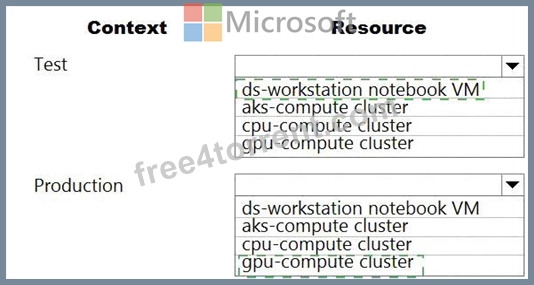
Explanation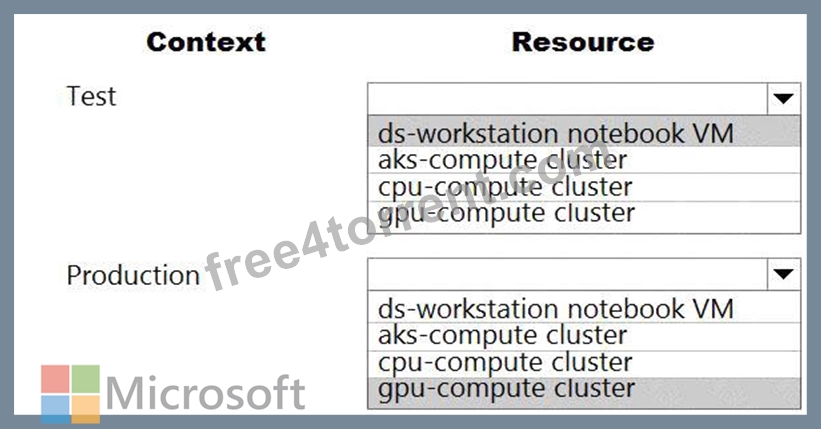
Box 1: ds-workstation notebook VM
An authenticated connection must not be required for testing.
On a Microsoft Azure virtual machine (VM), including a Data Science Virtual Machine (DSVM), you create local user accounts while provisioning the VM. Users then authenticate to the VM by using these credentials.
Box 2: gpu-compute cluster
Image classification is well suited for GPU compute clusters
Reference:
https://docs.microsoft.com/en-us/azure/machine-learning/data-science-virtual-machine/dsvm-common-identity
https://docs.microsoft.com/en-us/azure/architecture/reference-architectures/ai/training-deep-learning
NEW QUESTION # 82
You need to define a process for penalty event detection.
Which three actions should you perform in sequence? To answer, move the appropriate actions from the list of actions to the answer area and arrange them in the correct order.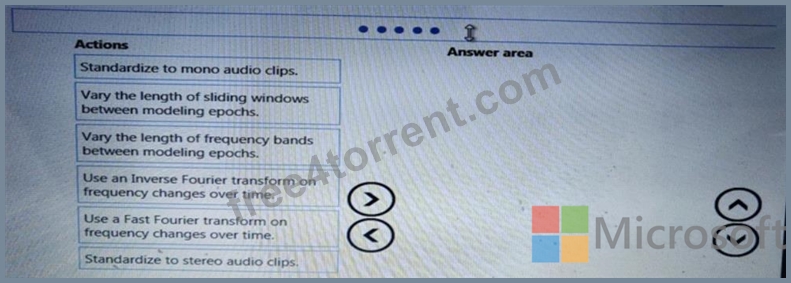
Answer:
Explanation: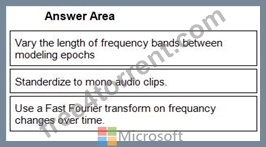
1 - Vary the length of frequency bands between modeling epochs
2 - Standerdize to mono audio clips.
3 - Use a Fast Fourier transform on frequancy changes over time.
NEW QUESTION # 83
You have a dataset created for multiclass classification tasks that contains a normalized numerical feature set with 10,000 data points and 150 features.
You use 75 percent of the data points for training and 25 percent for testing. You are using the scikit-learn machine learning library in Python. You use X to denote the feature set and Y to denote class labels.
You create the following Python data frames:
You need to apply the Principal Component Analysis (PCA) method to reduce the dimensionality of the feature set to 10 features in both training and testing sets.
How should you complete the code segment? To answer, select the appropriate options in the answer area.
NOTE: Each correct selection is worth one point.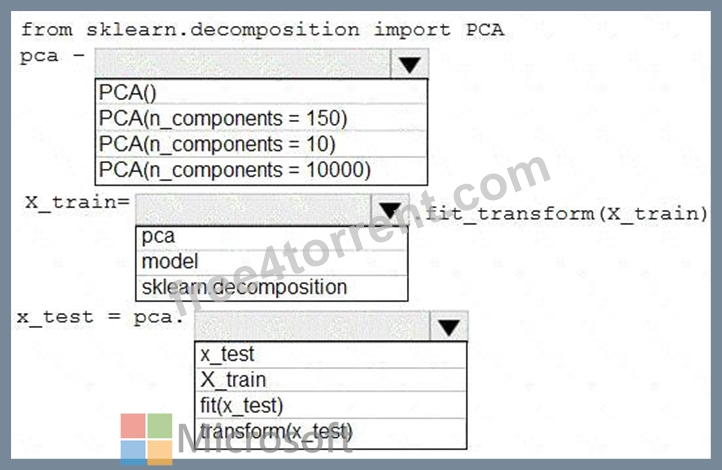
Answer:
Explanation: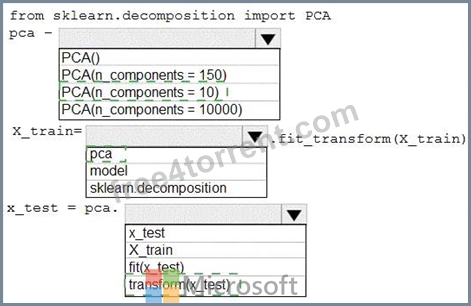
Explanation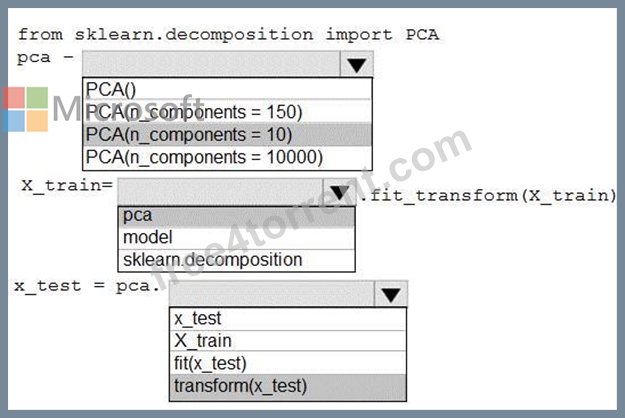
Box 1: PCA(n_components = 10)
Need to reduce the dimensionality of the feature set to 10 features in both training and testing sets.
Example:
from sklearn.decomposition import PCA
pca = PCA(n_components=2) ;2 dimensions
principalComponents = pca.fit_transform(x)
Box 2: pca
fit_transform(X[, y])fits the model with X and apply the dimensionality reduction on X.
Box 3: transform(x_test)
transform(X) applies dimensionality reduction to X.
References:
https://scikit-learn.org/stable/modules/generated/sklearn.decomposition.PCA.html
NEW QUESTION # 84
You register a model that you plan to use in a batch inference pipeline.
The batch inference pipeline must use a ParallelRunStep step to process files in a file dataset. The script has the ParallelRunStep step runs must process six input files each time the inferencing function is called.
You need to configure the pipeline.
Which configuration setting should you specify in the ParallelRunConfig object for the PrallelRunStep step?
- A. mini_batch_size= "6"
- B. error_threshold= "6"
- C. node_count= "6"
- D. process_count_per_node= "6"
Answer: C
Explanation:
node_count is the number of nodes in the compute target used for running the ParallelRunStep.
Incorrect Answers:
A: process_count_per_node
Number of processes executed on each node. (optional, default value is number of cores on node.) C: mini_batch_size For FileDataset input, this field is the number of files user script can process in one run() call. For TabularDataset input, this field is the approximate size of data the user script can process in one run() call.
Example values are 1024, 1024KB, 10MB, and 1GB.
D: error_threshold
The number of record failures for TabularDataset and file failures for FileDataset that should be ignored during processing. If the error count goes above this value, then the job will be aborted.
Reference:
https://docs.microsoft.com/en-us/python/api/azureml-contrib-pipeline-steps/ azureml.contrib.pipeline.steps.parallelrunconfig?view=azure-ml-py
NEW QUESTION # 85
......
Microsoft DP-100 Real 2026 Braindumps Mock Exam Dumps: https://dumpspdf.free4torrent.com/DP-100-valid-dumps-torrent.html